
B.E Electrical and Electronics Engineering
About the Department
The Department of Electrical and Electronics Engineering was established in the year 2008 intakes of 60 students. The Two Post Graduate Programme 1. M.E. Embedded System Technologies (EST) was established in the year 2013 intakes of 18 students. and 2. M.E. Power System Engineering (PSE) was established in the year 2013 intakes of 24 students. The department has dedicated and well expertise Faculty members. The faculty members publish papers periodically in reputed journals indexed by WOS, SCI and Scopus. Based on the infrastructure facility and faculty strength, the department was accorded approval by AICTE, New Delhi and affiliated to Anna University, Chennai to offer UG and PG Programmes.
The department has well equipped laboratories viz. Electrical Machines Lab, Engineering Practices Lab, Control and Instrumentation Lab, Power Electronics Lab, Electron Devices and Circuits Lab, Linear and Digital Integrated circuits lab, Renewable Energy Systems Lab, R&D Lab. They are upgraded from time to time to provide adequate opportunities for students to learn and innovate.
Department of Electrical & Electronics Engineering (EEE), deals with the problems, opportunities and needs of electrical, electronics, computer, telecommunication systems and related industries. This programme uses the concept of Science, Technology, and Problem-solving skills to design, construct, and maintain products, services, and information systems. This programme prepares students for careers as Design Engineer, Project Engineer, Engineering Specialist, Chief Engineer, Quality Control Engineer, Software Engineer, Development Engineer, Reliability Engineer, Research Engineer, Systems Design Engineer, Field Engineer, Test Engineer and Sales Engineer etc. Electrical Engineering serve as a starting point for the careers in many other diversified fields, ranging from Instrumentation Engineering, Energy Engineering, Mechatronics Engineering, Computer Science and Engineering Biomedical Engineering and Aerospace Engineering.
Our department promotes the professional skills of students through societies like Indian Society for Technical Education (ISTE) and Institute of Electrical and Electronics Engineers (IEEE). Career guidance Programme and entrepreneurship awareness Programme are also carried out through the association of EEE. This branch provides students with a wide range of fundamental knowledge in core disciplines such as electrical equipment’s, electronic devices, communications, control systems, signal processing, micro-processors, micro-electronics, power generation and electrical machines. The discipline focuses on design and manufacture of electrical, electronic devices, computers and their parts, as well as on the integration of components into complex systems.
Students from the department consistently perform well in academics, showcasing their technical abilities by winning several prizes in national and international Hackathons and contests. Beyond academics, the department focuses on enhancing students' careers by offering training in soft skills, personality development, and placement preparation, which helps them succeed in both the professional and personal realms. The technical and organizational skills of students are demonstrated through participation in national-level symposiums, conferences, and design and product development competitions. Additionally, the department facilitates industrial visits, in-plant training, and involvement in research and industrial projects, providing practical exposure to complement academic learning.
Electrical and Electronics Engineer’s job responsibilities include specification, design, development, and implementation of products or systems, as well as research to create new ideas. This role provides a number of challenges ranging from problem identification and the selection of appropriate technical solutions, materials, test equipment and procedures to manufacture and production of safe, economical, high-performance products and services. An electrical engineer may choose to couple the technical aspects of a position with management responsibilities. The latest technical expertise required for management is increasing because of the explosion of knowledge in engineering, technology, and science. Since the problem-solving skills acquired in an electrical engineering programme provide an extraordinarily valuable asset and it will equip them to assume leadership roles in their community and in professional circles outside the workplace.
Program Educational Objectives (PEO's)
PEO1: Apply strong foundations in Mathematics, Science, and Electrical & Electronics Engineering to analyze, design, and implement electrical circuits, power systems, and control systems.
PEO2: Excel as competent professionals, entrepreneurs, or researchers by developing innovative and sustainable solutions in renewable energy, electric mobility, automation, and smart power systems.
PEO3: Demonstrate leadership, teamwork, communication skills, ethical responsibility, and social awareness in multidisciplinary engineering environments.
PEO4: Engage in lifelong learning through higher education, professional certifications, research, and adaptation to evolving technologies such as Smart Grids, AI-integrated systems, and Energy Analytics.
Programme Specific Outcomes (PSO's)
PSO1: Analyze and design electrical machines, power systems, control systems, power electronics, and instrumentation systems using modern engineering tools.
PSO2: Develop and implement intelligent electrical systems for Electric Vehicles, Renewable Energy Systems, Smart Grids, Industrial Automation, and Embedded Energy Applications.
PSO3: Apply computing platforms, simulation software, and data analytics tools for power system optimization, energy management, and hybrid renewable energy integration.
Vision
To emerge as a Centre of Excellence in Electrical and Electronics Engineering by fostering innovation, sustainable energy solutions, ethical practices, and industry-oriented education to produce globally competent engineers and entrepreneurs.
Mission
- To deliver outcome-based education through contemporary curriculum, advanced laboratories, smart classrooms, and industry-integrated pedagogy in emerging areas such as Smart Grids, Electric Vehicles, Renewable Energy Systems, Automation, Robotics, and AI-driven power systems.
- To equip students with strong technical competence, analytical skills, and hands-on experience to enhance employability in core electrical and allied industries.
- To promote research, innovation, consultancy, and start-up culture in areas of clean energy, energy storage, industrial automation, and intelligent control systems.
- To strengthen industry–academia collaboration through internships, industrial training, live projects, certifications, and skill development programs.
- To inculcate ethical values, environmental consciousness, leadership qualities, and social responsibility for sustainable technological development.
Quality Objectives
- To achieve CO–PO attainment levels above the benchmark target (≥ 60%) through continuous academic monitoring.
- To improve placement percentage in core electrical, renewable energy, EV, automation, and allied industries annually.
- To enhance research output through publications, patents, funded projects, and consultancy in emerging electrical technologies.
- To organize workshops, FDPs, industry-certified training, and skill enhancement programs in EV technology, PLC/SCADA, Solar PV systems, and Power Electronics.
- To encourage student start-ups, prototype development, and entrepreneurship in energy and automation sectors.
- To strengthen MoUs with industries, power plants, renewable energy firms, and automation companies.
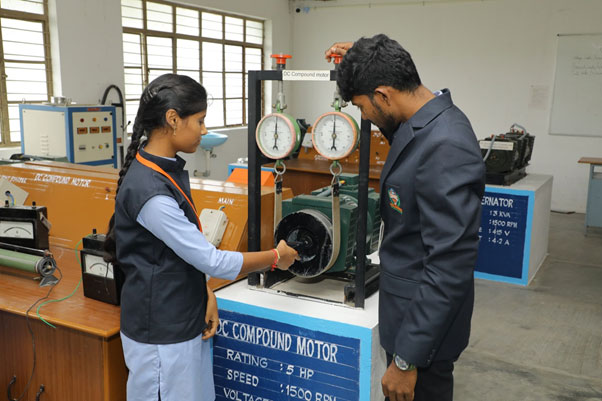
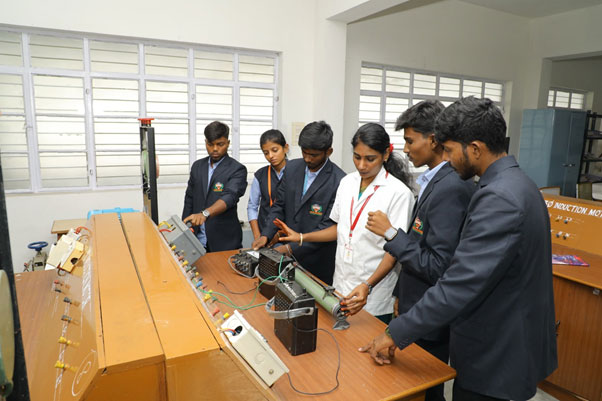
Electrical Machines Laboratory
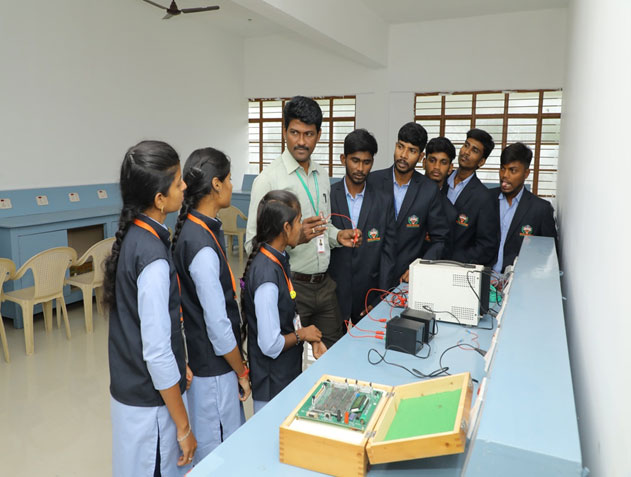
Power Electronics Laboratory
Micro Processor and Micro Controller Laboratory
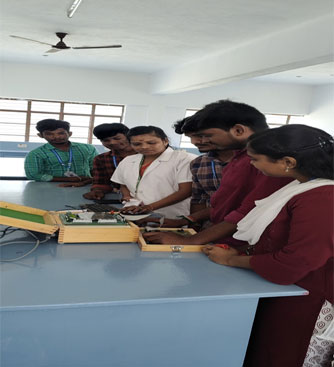
Electron Devices and Circuits Laboratory
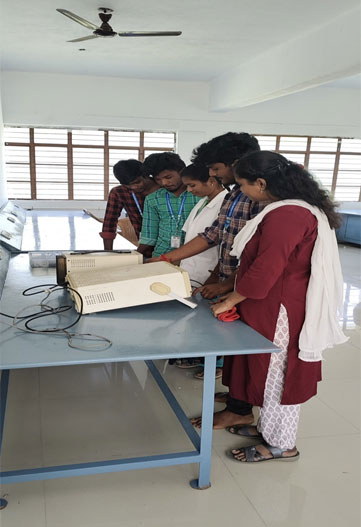
Linear Integrated and Circuits Laboratory
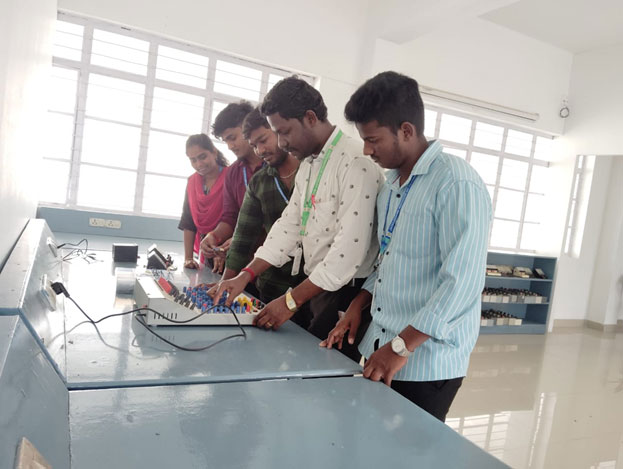
Faculty Details
| Sl.No | Name & Designation | AU - FIN | AICTE ID | Photo |
|---|---|---|---|---|
| 1 | C.Suresh Assistant Professor |
2664421985 | 1-44720431753 |  |
| 2 | M.Chandrasekaran Assistant Professor |
2635071988 | 1-43396904741 |  |
| 3 | M.Balasubramanian Assistant Professor |
2661111981 | 1-4661463106 |  |
| 4 | S.Jaichitra Assistant Professor |
2655551989 | 1-2998191349 |  |
| 5 | S.Naveena Assistant Professor |
2636491995 | 1-4931446161 |  |
| 6 | G.Manjula Assistant Professor |
2645462000 | 1-4472462553 |  |
| 7 | T.Paavendhan Assistant Professor |
2610601987 | 1-46614642682 |  |
| 8 | D.Sumithra Assistant Professor |
2620101989 | 1-43413469831 |  |
| 9 | A.Santhiya Assistant Professor |
2665261994 | 1-46614642763 |  |

Placement
Coming Soon
Achievements
Coming Soon
Event
Coming Soon